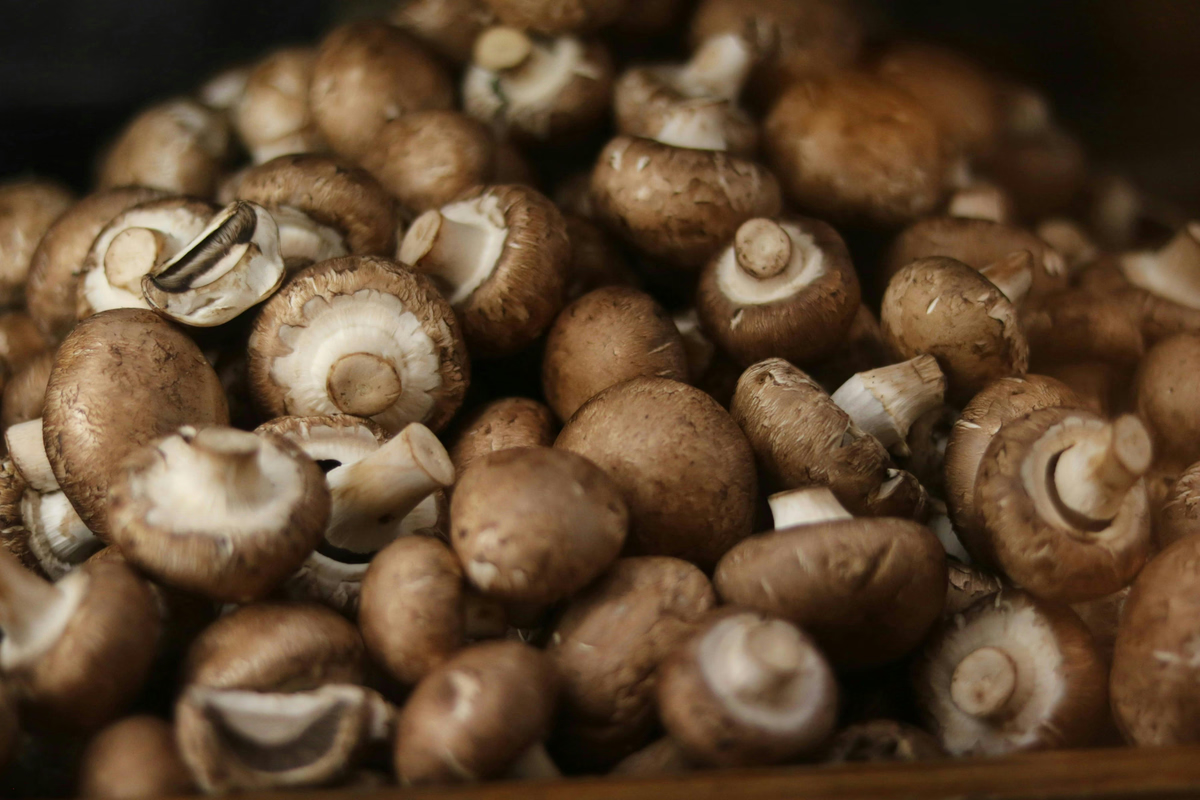
Mushrooms, crimini
Serving: 1.00 cup (72g, 16 cal)
Key Nutrients
| Nutrient | Amount | DV% | Rating |
|---|---|---|---|
| copper | 0.36 mg | 40% | Excellent |
| selenium | 18.72 mcg | 34% | Excellent |
| vitamin B2 | 0.35 mg | 27% | Excellent |
| pantothenic acid | 1.08 mg | 22% | Excellent |
| vitamin B3 | 2.74 mg | 17% | Excellent |
| phosphorus | 86.4 mg | 12% | Excellent |
| zinc | 0.79 mg | 7% | Very Good |
| potassium | 322.56 mg | 7% | Very Good |
| vitamin B1 | 0.07 mg | 6% | Very Good |
| vitamin B6 | 0.08 mg | 5% | Good |
| folate | 18 mcg | 5% | Good |
| manganese | 0.1 mg | 4% | Good |
| choline | 15.91 mg | 4% | Good |
| protein | 1.8 g | 4% | Good |
| vitamin B12 | 0.07 mcg | 3% | Good |
| vitamin B5 | 1.3 mg | 13% | Excellent |
| dietary fiber | 0.85 g | 3.4% | Good |
| magnesium | 6.48 mg | 2% | Good |
| iron | 0.29 mg | 2% | Good |
| calcium | 12.96 mg | 1% | Good |
copper
Excellent 0.36 mg 40% DV
selenium
Excellent 18.72 mcg 34% DV
vitamin B2
Excellent 0.35 mg 27% DV
pantothenic acid
Excellent 1.08 mg 22% DV
vitamin B3
Excellent 2.74 mg 17% DV
phosphorus
Excellent 86.4 mg 12% DV
zinc
Very Good 0.79 mg 7% DV
potassium
Very Good 322.56 mg 7% DV
vitamin B1
Very Good 0.07 mg 6% DV
vitamin B6
Good 0.08 mg 5% DV
folate
Good 18 mcg 5% DV
manganese
Good 0.1 mg 4% DV
choline
Good 15.91 mg 4% DV
protein
Good 1.8 g 4% DV
vitamin B12
Good 0.07 mcg 3% DV
vitamin B5
Excellent 1.3 mg 13% DV
dietary fiber
Good 0.85 g 3.4% DV
magnesium
Good 6.48 mg 2% DV
iron
Good 0.29 mg 2% DV
calcium
Good 12.96 mg 1% DV
About Mushrooms, crimini
What’s new and beneficial about crimini mushrooms
- Crimini mushrooms (Agaricus bisporus) are one of the few non-animal foods that contain measurable vitamin B12. HPLC and mass spectrometry analysis confirmed the corrinoid in cultivated button mushrooms matches authentic B12 rather than inactive pseudovitamin analogs. Three caveats limit confidence in this finding. B12 is not always detected across batches. Concentrations are highest in the outer peel, suggesting bacterial origin on the mushroom surface rather than biosynthesis by the fungus itself. Other mushroom species (notably lion’s mane) contain B12[c-lactone], an inactive corrinoid. Crimini mushrooms should not serve as a primary B12 source, but they may contribute meaningfully for people who eat them regularly.
- Storage temperature affects both texture and phytonutrient retention. Over six to eight days, mushrooms stored at 38°F (3°C) maintained color and firmness, while those approaching 59°F (15°C) showed progressive browning and hardening. The likely mechanism: polyphenol oxidase, an enzyme that degrades phenolic antioxidants, becomes more active at higher temperatures. Fungi lack the rigid cellulose cell walls that slow enzymatic degradation in plants, making them more susceptible. Refrigerate promptly after purchase.
- Cooking method affects antioxidant retention. In one comparison, microwaving (2 min) and boiling (5 min) both reduced total antioxidant capacity, while stir-frying (2 min) slightly increased it. Water-soluble antioxidants likely leached into cooking liquid during the wet-heat methods. Sauteing in oil avoids this loss pathway.
- In a 16-week trial, 37 adults with metabolic syndrome ate 100g of cooked mushrooms daily. Plasma ergothioneine (a sulfur-containing amino acid with antioxidant activity) doubled. Serum markers of oxidative stress, including advanced glycation end products, decreased. Total antioxidant capacity increased. The dose was substantial, roughly one cup per day, but the ergothioneine accumulation suggests even moderate intake could shift circulating levels over time.
Nutritional profile
One cup (72g) of raw crimini mushrooms provides 16 calories and notable concentrations of copper (40% DV), selenium (34% DV), riboflavin (27% DV), pantothenic acid (22% DV), and niacin (22% DV). The same serving supplies phosphorus (15% DV), zinc (11% DV), potassium (8% DV), thiamin (7% DV), and manganese (7% DV). Smaller but measurable amounts of B6, folate, choline, protein, and B12 round out the profile. The mineral density relative to calorie content is unusually high.
Individual concerns
Crimini mushrooms and purines
“What are purines and in which foods are they found?”
For sautéing, a tri-ply stainless pan like the All-Clad D3 Stainless Sauté Pan gives you even heat and a good sear without non-stick coatings.
Recipes with Mushrooms, crimini
- 7-Minute Healthy Sautéed Crimini Mushrooms
- Mushroom, Tomato, Basil Frittata
- Poached Eggs over Spinach & Mushrooms
- Crispy Turkey Salad
- Barley Mushroom Soup
- Minestrone Surprise
- Broiled Rosemary Chicken over Puréed Lentils and Swiss Chard
- Holiday Turkey with Rice Stuffing & Gravy with Fresh Herbs
- Braised Kidney Beans & Sweet Potato
- Asian Mushroom Sauté
- Baked Potato with Rosemary, Mushroom Sauce
- Wild Rice Pilaf
- Asian Sautéed Cauliflower
- 7-Minute "Quick Steamed" Butternut Squash
- 5-Minute "Quick Steamed" Brussels Sprouts
- Rosemary "Quick Broiled" Lamb
- Pearl Couscous with Seared Scallops and Wild Mushrooms — MK Library
- Mushroom Foraging for Morels at Mount Shasta — MK Library
Full Nutrient Profile
Related Articles
- Can you tell me more about green tea?
- If I am Mostly Eating Plant Foods, do I Still Need to be Concerned About Food Quality?
- Is Vitamin B12 Really a Problem in a Vegetarian Diet?
- What Do You Think About a Mostly Vegetarian-Plus-Dairy/Eggs Meal Plan?
- What Do You Think About a Mostly Vegetarian-Plus-Seafood Meal Plan?
- What Foods are Covered and What Foods are Not Covered Under the Current Organic Standards?
- What if I Eat Vegetarian Most of the Time, but Enjoy Meat and Poultry on Occasion?
References
- Adams LS, Phung S, Wu X et al. White button mushroom (Agaricus bisporus) exhibits antiproliferative and proapoptotic properties and inhibits prostate tumor growth in athymic mice. Nutr Cancer. 2008;60(6):744-56. 2008. https://doi.org/10.1080/01635580802192866
- Akbarirad H, Kazemeini SM, and Shariaty MA. Deterioration and some of applied preservation techniques for common mushrooms (Agaricus bisporus, followed by Lentinus edodes, Pleurotus spp.). Journal of Microbiology, Biotechnology and Food Sciences, 2013, 2, 6, pp. 2398-2402.
- Arora B. Effect of cooking on antioxidant activity and phenolic content of various species of edible mushrooms of India. Proceedings of 8th International Conference on Mushroom Biology and Mushroom Products (ICMBMP8), New Delhi, India, 19-22 November 2014. Volume I & II, 2014, pp. 576-581.
- Calvo MS, Mehrotra A, Beelman RB, et al. A Retrospective Study in Adults with Metabolic Syndrome: Diabetic Risk Factor Response to Daily Consumption of Agaricus bisporus (White Button Mushrooms). Plant Foods Hum Nutr. 2016 Sep;71(3):245-51. https://doi.org/10.1007/s11130-016-0552-7
- Caz V, Gil-Ramirez A, Largo C, et al. Modulation of Cholesterol-Related Gene Expression by Dietary Fiber Fractions from Edible Mushrooms. J Agric Food Chem. 2015 Aug 26;63(33):7371-80. https://doi.org/10.1021/acs.jafc.5b02942
- Chandra L, Alexander H, Traoré D et al. White button and shiitake mushrooms reduce the incidence and severity of collagen-induced arthritis in dilute brown non-agouti mice. J Nutr. 2011 Jan;141(1):131-6. Epub 2010 Nov 24. 2011.
- Chen S, Oh SR, Phung S et al. Anti-Aromatase Activity of Phytochemicals in White Button Mushrooms (Agaricus bisporus). Cancer Res., Dec 2006; 66: 12026 - 12034. 2006. https://doi.org/10.1158/0008-5472.can-06-2206
- Grube BJ, Eng ET, Kao YC et al. White Button Mushroom Phytochemicals Inhibit Aromatase Activity and Breast Cancer Cell Proliferation. J. Nutr., Dec 2001; 131: 3288 - 3293. 2001. https://doi.org/10.1158/0008-5472.can-06-2206
- Jeong SC, Koyyalamudi SR, and Pang G. Dietary intake of Agaricus bisporus white button mushroom accelerates salivary immunoglobulin A secretion in healthy volunteers. Nutrition. 2012 May;28(5):527-31. https://doi.org/10.1016/j.nut.2011.08.005
- Jeong SC, Koyyalamudi SR, Jeong YT, et al. Macrophage immunomodulating and antitumor activities of polysaccharides isolated from Agaricus bisporus white button mushrooms. J Med Food. 2012 Jan;15(1):58-65. https://doi.org/10.1089/jmf.2011.1704
- Jeong SC, Jeong YT, Yang BK et al. White button mushroom (Agaricus bisporus) lowers blood glucose and cholesterol levels in diabetic and hypercholesterolemic rats. Nutr Res. 2010 Jan;30(1):49-56. 2010. https://doi.org/10.1016/j.nutres.2009.12.003
- Khan AA, Gani A, Masoodi FA, et al. Antioxidant and functional properties of beta-glucan extracted from edible mushrooms Agaricus bisporus, Pleurotus ostreatus and Coprinus atramentarius. Proceedings of 8th International Conference on Mushroom Biology and Mushroom Products (ICMBMP8), New Delhi, India, 19-22 November 2014. Volume I & II, 2014, pp. 210-214. https://doi.org/10.3390/molecules26020251
- Kim MY, Seguin P, Ahn JK et al. Phenolic compound concentration and antioxidant activities of edible and medicinal mushrooms from Korea. J Agric Food Chem. 2008 Aug 27;56(16):7265-70. Epub 2008 Jul 11. 2008. https://doi.org/10.37871/jbres2070
- Komura DL, Carbonero ER, Gracher AH et al. Structure of Agaricus spp. fucogalactans and their anti-inflammatory and antinociceptive properties. Bioresour Technol. 2010 Aug;101(15):6192-9. Epub 2010 Apr 2. 2010. https://doi.org/10.1016/j.biortech.2010.01.142
- Koyyalamudi SR, Jeong SC, Cho KY, et al. Vitamin B12 Is the Active Corrinoid Produced in Cultivated White Button Mushrooms (Agaricus bisporus). J. Agric. Food Chem., 2009, 57 (14), pp. 6327,6333. https://doi.org/10.1016/j.jnutbio.2020.108453
- Martin KR and Brophy SK. Commonly consumed and specialty dietary mushrooms reduce cellular proliferation in MCF-7 human breast cancer cells. Exp Biol Med (Maywood). 2010 Nov 1;235(11):1306-14. Epub 2010 Oct 4. 2010. https://doi.org/10.1258/ebm.2010.010113
- Martin KR. Both common and specialty mushrooms inhibit adhesion molecule expression and in vitro binding of monocytes to human aortic endothelial cells in a pro-inflammatory environment. Nutr J. 2010 Jul 16;9:29. 2010. https://doi.org/10.1186/1475-2891-9-29
- Mohapatra D, Bira ZM, Kerry JP et al. Postharvest hardness and color evolution of white button mushrooms (Agaricus bisporus). J Food Sci. 2010 Apr;75(3):E146-52. 2010. https://doi.org/10.1111/j.1750-3841.2010.01518.x
- Muszynska B, Kala K, Rojowski J, et al. Composition and biological properties of Agaricus bisporus fruiting bodies - a review. Polish Journal of Food and Nutrition Sciences, 2017, 67, 3, pp. 173-181. https://doi.org/10.1515/pjfns-2016-0032
- Phung S, Ye J, Hur G et al. White button mushrooms and prostate cancer prevention. AACR Meeting Abstracts, Apr 2005; 2005: 1221. 2005.
- Radzki W, Slawinska A, Jablonska-Rys E, et al. Effect of blanching and cooking on antioxidant capacity of cultivated edible mushrooms: a comparative study. International Food Research Journal, 2016, 23, 2, pp. 599-605.
- Ramkumar L, Ramanathan T, Thirunavukkarasu P et al. Antioxidant and Radical Scavenging Activity of Nine Edible Mushrooms Extract. International Journal of Pharmacology Year: 2010 Vol: 6 Issue: 6 Pages/record No.: 950-953. 2010. https://doi.org/10.3923/ijp.2010.950.953
- Ren Z, Guo Z, Meydani SN and Wu D. White button mushroom enhances maturation of bone marrow-derived dendritic cells and their antigen presenting function in mice. J Nutr. 2008 Mar;138(3):544-50. 2008. https://doi.org/10.1093/jn/138.3.544
- Ruthes AC, Rattmann YD, Malquevicz-Paiva SM, et al. Agaricus bisporus fucogalactan: structural characterization and pharmacological approaches. Carbohydr Polym. 2013 Jan 30;92(1):184-91. https://doi.org/10.1016/j.carbpol.2012.08.071
- Shao S, Hernandez M, Kramer JK et al. Ergosterol profiles, fatty acid composition, and antioxidant activities of button mushrooms as affected by tissue part and developmental stage. J Agric Food Chem. 2010 Nov 24;58(22):11616-25. Epub 2010 Oct 20. 2010.
- Smiderle FR, Sassaki GL, van Arkel J et al. High molecular weight glucan of the culinary medicinal mushroom Agaricus bisporus is an alpha-glucan that forms complexes with low molecular weight galactan. Molecules. 2010 Aug 25;15(8):5818-30. 2010. https://doi.org/10.3390/molecules25122811
- Thangthaeng N, Miller MG, Gomes SM, et al. Daily supplementation with mushroom (Agaricus bisporus) improves balance and working memory in aged rats. Nutrition Research, Volume 35, Issue 12, December 2015, pages 1079-1084. https://doi.org/10.1016/j.nutres.2015.09.012
- Um MY, Park JH, Gwon SY, et al. Agaricus bisporus attenuates dextran sulfate sodium-induced colitis. J Med Food. 2014 Dec;17(12):1383-5. https://doi.org/10.1089/jmf.2014.3191
- Weigand-Heller AJ, Kris-Etherton PM, and Beelman RB. The bioavailability of ergothioneine from mushrooms (Agaricus bisporus) and the acute effects on antioxidant capacity and biomarkers of inflammation. Prev Med. 2012 May;54 Suppl:S75-8. https://doi.org/10.1016/j.ypmed.2011.12.028
- Wu D, Pae M, Ren Z et al. Dietary supplementation with white button mushroom enhances natural killer cell activity in C57BL/6 mice. J Nutr. 2007 Jun;137(6):1472-7. 2007. https://doi.org/10.1093/jn/137.6.1472
- You WX, Cui TJ, and Juan W. Effect of precooling temperature on physiological quality of cold stored Agaricus bisporus. International Journal of Agricultural and Biological Engineering , 2014, 7, 2, pp. 108-114. https://doi.org/10.25165/ijabe.v7i2.875
- Yu S, Weaver V, Martin K et al. The effects of whole mushrooms during inflammation. BMC Immunol. 2009 Feb 20;10:12. 2009. https://doi.org/10.1186/1471-2172-10-12
- Xu T, Beelman RB, and Lambert JD. The cancer preventive effects of edible mushrooms. Anticancer Agents Med Chem. 2012 Dec;12(10):1255-63. https://doi.org/10.2174/187152012803833017
- Zhu BZ, Mao L, Fan RM et al. Ergothioneine prevents copper-induced oxidative damage to DNA and protein by forming a redox-inactive ergothioneine-copper complex. Chem Res Toxicol. 2011 Jan 14;24(1):30-4. Epub 2010 Nov 3. 2011. https://doi.org/10.1021/tx100214t
- Borchers AT, Krishnaumurthy A, Keen CL et al. The Immunobiology of Mushrooms. Exp Biol Med, Mar 2008; 233: 259 - 276. 2008. https://doi.org/10.3181/0708-mr-227
- Falandysz J. Selenium in edible mushrooms. J Environ Sci Health C Environ Carcinog Ecotoxicol Rev. 2008 Jul-Sep;26(3):256-99. 2008. https://doi.org/10.1080/10590500802350086
- García MA, Alonso J and Melgar MJ. Lead in edible mushrooms: levels and bioaccumulation factors. J Hazard Mater. 2009 Aug 15;167(1-3):777-83. Epub 2009 Jan 23. 2009.
- Giannenas I, Pappas IS, Mavridis S et al. Performance and antioxidant status of broiler chickens supplemented with dried mushrooms (Agaricus bisporus) in their diet. Poult Sci. 2010 Feb;89(2):303-11. 2010. https://doi.org/10.3382/ps.2009-00207
- Gohil VM, Agrawal SK, Saxena AK et al. Synthesis, biological evaluation and molecular docking of aryl hydrazines and hydrazides for anticancer activity. Indian J Exp Biol. 2010 Mar;48(3):265-8. 2010.
- Kohno K, Miyake M, Sano O et al. Anti-inflammatory and immunomodulatory properties of 2-amino-3H-phenoxazin-3-one. Biol Pharm Bull. 2008 Oct;31(10):1938-45. 2008. https://doi.org/10.1248/bpb.31.1938
- Koyyalamudi SR, Jeong SC, Cho KY et al. Vitamin B12 is the active corrinoid produced in cultivated white button mushrooms (Agaricus bisporus). J Agric Food Chem. 2009 Jul 22;57(14):6327-33. 2009. https://doi.org/10.1016/j.jnutbio.2020.108453
- Koyyalamudi SR, Jeong SC, Song CH et al. Vitamin D2 formation and bioavailability from Agaricus bisporus button mushrooms treated with ultraviolet irradiation. J Agric Food Chem. 2009 Apr 22;57(8):3351-5. 2009. https://doi.org/10.1021/jf803908q
- Kwok S, Yuan YC, Karlsberg K et al. Molecular basis of the chemoprotective effect of white button mushrooms against breast cancer. [Proc Amer Assoc Cancer Res, Volume 46, 2005] Prevention Research 3: Biological and Biochemical Mechanisms in Prevention. Abstract #1580. 2005.
- Melgar MJ, Alonso J and García MA. Mercury in edible mushrooms and underlying soil: bioconcentration factors and toxicological risk. Sci Total Environ. 2009 Oct 1;407(20):5328-34. Epub 2009 Jul 24. 2009. https://doi.org/10.1016/j.scitotenv.2009.07.001
- Roberts JS, Teichert A and McHugh TH. Vitamin D2 formation from post-harvest UV-B treatment of mushrooms (Agaricus bisporus) and retention during storage. J Agric Food Chem. 2008 Jun 25;56(12):4541-4. Epub 2008 Jun 4. 2008.
- Shiuan C. Anticancer Activities of White Button Mushrooms. The Journal of Nutrition. Bethesda: Dec 2004. Vol. 134, Iss. 12S; pg. 3532S-3533S. 2004. https://doi.org/10.1158/0008-5472.can-06-2206